One of the things I’ve been thinking about lately and especially after this week’s core readings is access to digital technology. It’s so wild to me that as teachers we are responsible for preparing children for jobs that haven’t even been created yet and we don’t even have the technology in our classrooms to support such learning.
I was doing some reading on digital tech in early childhood classrooms and their advice, in terms of what tech to purchase, was a digital microscope, an iPad, and a digital camera. None of these items are available when a new teacher walks into the classroom and yet are considered necessities by experts in the field. All you get when you walk into a classroom is stacks and stacks of curriculum. If you want tools like the aforementioned you have to write grants for them or pay out of your own pocket.
I don’t think it’s any surprise that there is a lot of inequity from district to district. Edmonds is 2:1 with Chromebooks for kindergarten and Lake Washington has class sets of iPads. And I know I should be grateful for what I have because there are children who don’t have access to any computers. How can we create more equity and close this digital gap? Anymore, districts are putting serious boundaries around what tech teachers can write grants for and what they can’t. For example, in my district a policy was recently released stating you can only write grants for technology that is supported by Google chrome because that is what the district supports and pays for. I have Chromebooks in my classroom, but find them extremely frustrating to use creatively with kindergarteners. Despite these challenges, even if I wanted to provide my students with tools that were more developmentally user friendly, (cough, iPads, cough cough) the district wouldn’t allow it. This complicates the equity issue even more. From one angle I’m trying to create more equity for my students in comparison to other districts, but from another angle, I could be creating inequity in my own district.
I hate that more demands are being put on me (we now have computer science standards we are obligated to teach) and yet we don’t have the proper technology to teach it. I’ve written grants for robots and incredible programs such as the Dash robot, Cosmo, Osmo software, and more, but it’s becoming increasingly more difficult to get those materials in the classroom. The district has put together “code” boxes that I piloted last year that are supposed to be rotated around the 20+ elementary schools in my district, but we all know that are students should have access to these materials everyday!
There is only one solution…fully fund education!
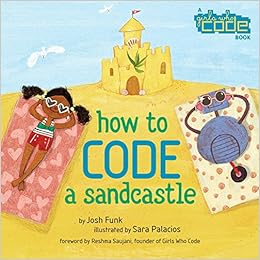 The children’s book I’ve chosen to accompany this post is called “How to Code A Sandcastle” by Josh Funk. This is a great picture book to use to introduce kids to coding. I also love that the main character in the book is a female, which I LOVE because it addresses the lack of female representation in science. The gist of the story is that all summer long Pearl is trying to build the perfect sandcastle, but various obstacles keep knocking it over. In her last attempt before summer vacation is over, but with the help of her robot pal, Pascal, she decides to use code to build her masterpiece.


So many schools seem to still be struggling with how to provide basic access. I just saw a new release from another school that boasted of teaching all kids to code and also that their main technology was chromebooks, and I sighed. I applaud your tenacity in getting better access in your classroom.
Have you checked out Scratch Jr? https://www.scratchjr.org/ Scratch is great, but I know less about the Junior version.
This vague goal of doing “tech” is getting in the way of kids doing meaningful and purposeful things with digital tools, sometimes.
LikeLike
I am familiar with Scratch Jr! Our district doesn’t let you download apps from the google store without going through the proper channels, so it’s on my list! My kids really enjoy Kodable, but I like the story telling component of Scratch Jr.
LikeLike